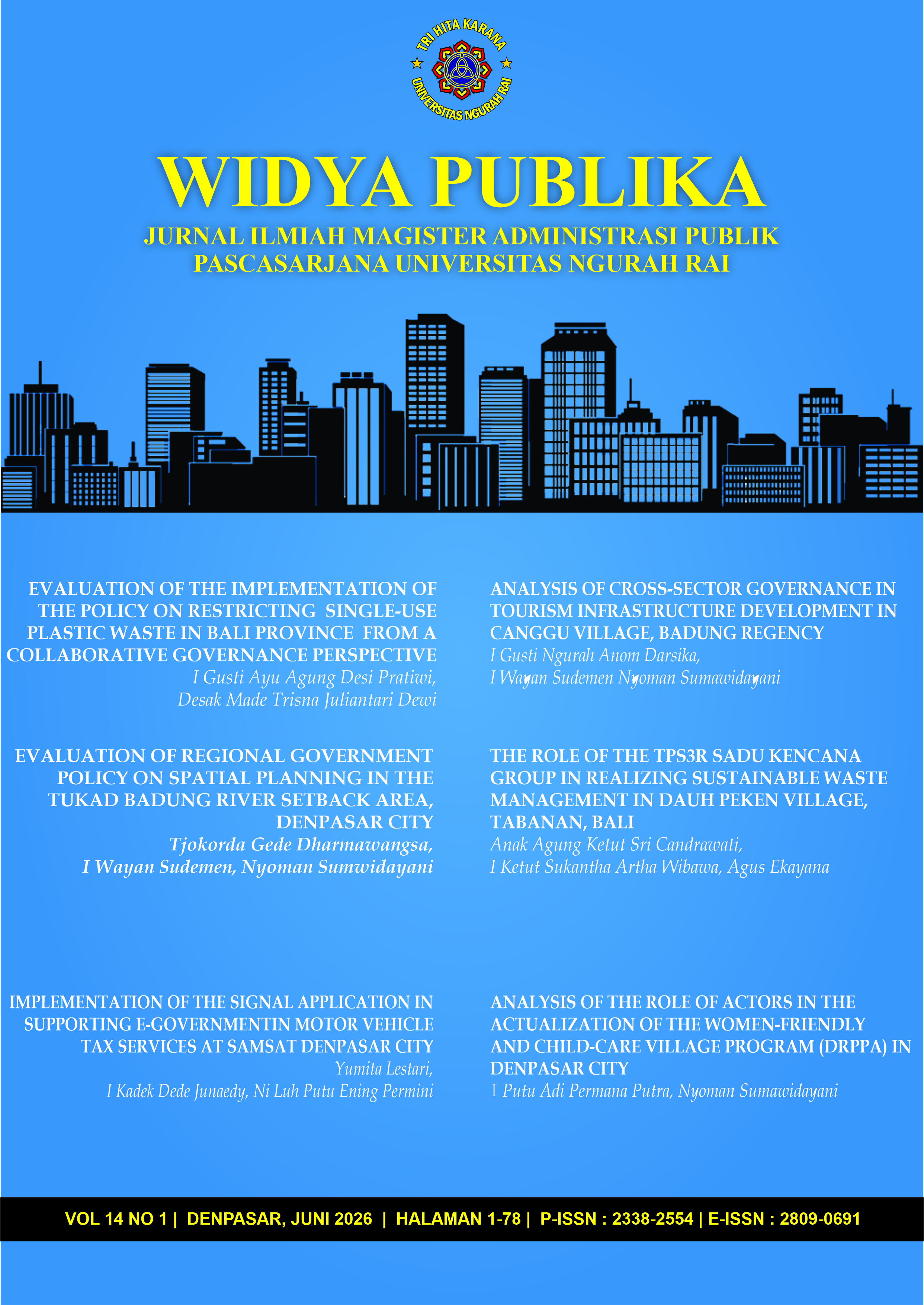
EVALUATION OF THE IMPLEMENTATION OF THE POLICY ON RESTRICTING SINGLE-USE PLASTIC WASTE IN BALI PROVINCE FROM A COLLABORATIVE GOVERNANCE PERSPECTIVE
DOI:
https://doi.org/10.70358/widyapublika.v14i1.1899Keywords:
Collaborative Governance, Policy Evaluation, Single-Use Plastic, Policy Implementation, Bali.Abstract
Plastic waste has become one of the most critical environmental challenges affecting sustainable development in Bali Province as an international tourism destination. The Provincial Government of Bali enacted Governor Regulation Number 97 of 2018 concerning the Restriction of Single-Use Plastic Waste to reduce the consumption of plastic bags, plastic straws, and styrofoam. Although the implementation of this policy has demonstrated significant progress, several challenges remain, including inconsistent compliance among business actors, limited enforcement, and insufficient collaboration among stakeholders. This study aims to evaluate the implementation of Bali's single-use plastic restriction policy using the Collaborative Governance perspective. A qualitative policy research approach was employed through document analysis, observation, and in-depth interviews involving government agencies, business actors, environmental organizations, customary villages, and local communities. Data were analyzed using the Miles, Huberman, and Saldaña interactive model. The findings indicate that policy implementation has been supported by government commitment, community participation, private sector engagement, and the active role of customary villages. However, inter-agency coordination, monitoring mechanisms, and stakeholder collaboration require further improvement. Strengthening a Collaborative Governance model based on local institutions is recommended to enhance sustainable environmental governance in Bali.
Keywords: Collaborative Governance, Policy Evaluation, Single-Use Plastic, Policy Implementation, Bali.
References
Ansell, C., & Gash, A. (2008). Collaborative governance in theory and practice. Journal of Public Administration Research and Theory, 18(4), 543–571. https://doi.org/10.1093/jopart/mum032
Badan Pusat Statistik Provinsi Bali. (2024). Provinsi Bali dalam angka 2024. Badan Pusat Statistik Provinsi Bali.
Bryson, J. M., Crosby, B. C., & Stone, M. M. (2015). Designing and implementing cross‐sector collaborations: Needed and challenging. Public Administration Review, 75(5), 647–663. https://doi.org/10.1111/puar.12432
Creswell, J. W., & Poth, C. N. (2018). Qualitative inquiry and research design: Choosing among five approaches (4th ed.). Sage Publications.
Dunn, W. N. (2018). Public policy analysis: An integrated approach (6th ed.). Routledge.
Emerson, K., & Nabatchi, T. (2015). Collaborative governance regimes. Georgetown University Press.
Emerson, K., Nabatchi, T., & Balogh, S. (2012). An integrative framework for collaborative governance. Journal of Public Administration Research and Theory, 22(1), 1–29. https://doi.org/10.1093/jopart/mur011
George, C. E. (1980). Implementing public policy. Congressional Quarterly Press.
Kementerian Lingkungan Hidup dan Kehutanan Republik Indonesia. (2024). Sistem Informasi Pengelolaan Sampah Nasional (SIPSN): Capaian kinerja pengelolaan sampah Indonesia tahun 2023. Direktorat Jenderal Pengelolaan Sampah, Limbah, dan Bahan Berbahaya dan Beracun.
Miles, M. B., Huberman, A. M., & Saldaña, J. (2014). Qualitative data analysis: A methods sourcebook (3rd ed.). Sage Publications.
Ostrom, E. (2010). Beyond markets and states: Polycentric governance of complex economic systems. American Economic Review, 100(3), 641–672. https://doi.org/10.1257/aer.100.3.641
Peraturan Daerah Provinsi Bali Nomor 5 Tahun 2011 tentang Pengelolaan Sampah.
Peraturan Gubernur Bali Nomor 47 Tahun 2019 tentang Pengelolaan Sampah Berbasis Sumber.
Peraturan Gubernur Bali Nomor 97 Tahun 2018 tentang Pembatasan Timbulan Sampah Plastik Sekali Pakai.
Pierre, J., & Peters, B. G. (2021). Governance, politics and the state (2nd ed.). Red Globe Press.
Sugiyono. (2023). Metode penelitian kualitatif. Alfabeta.
Surat Edaran Gubernur Bali Nomor 2 Tahun 2025 tentang Implementasi Peraturan Gubernur Bali Nomor 97 Tahun 2018 tentang Pembatasan Timbulan Sampah Plastik Sekali Pakai.
United Nations. (2015). Transforming our world: The 2030 agenda for sustainable development. United Nations.
United Nations Environment Programme. (2023). Turning off the tap: How the world can end plastic pollution and create a circular economy. United Nations Environment Programme.
Undang-Undang Republik Indonesia Nomor 18 Tahun 2008 tentang Pengelolaan Sampah.
Van Meter, D. S., & Van Horn, C. E. (1975). The policy implementation process: A conceptual framework. Administration & Society, 6(4), 445–488. https://doi.org/10.1177/009539977500600404
World Bank. (2021). Market study for Indonesia: Plastic circularity opportunities and barriers. World Bank.
Yin, R. K. (2018). Case study research and applications: Design and methods (6th ed.). Sage Publications.
Published
Issue
Section
License
Copyright (c) 2026 I Gusti Ayu Agung Desi Pratiwi, Desak Made Trisna Juliantari Dewi

This work is licensed under a Creative Commons Attribution-NonCommercial 4.0 International License.
Authors whose manuscript is published will approve the following provisions:
-
The right to publication of all journal material published on the WIDYA PUBLIKA journal website is held by the editorial board with the author's knowledge (moral rights remain the property of the author).
-
The formal legal provisions for access to digital articles of this electronic journal are subject to the terms of the Creative Commons Attribution-ShareAlike (CC BY-SA) license, which means Jurnal of WIDYA PUBLIKA reserves the right to store, modify the format, administer in the database, maintain and publish articles without requesting permission from the Author as long as it keeps the Author's name as the owner of Copyright.
-
Printed and electronically published manuscripts are open access for educational, research, and library purposes. In addition to these objectives, the editorial board shall not be liable for violations of copyright law.